US customs seizes $9.2m worth of counterfeit jewelry, exposing supply chain vulnerabilities

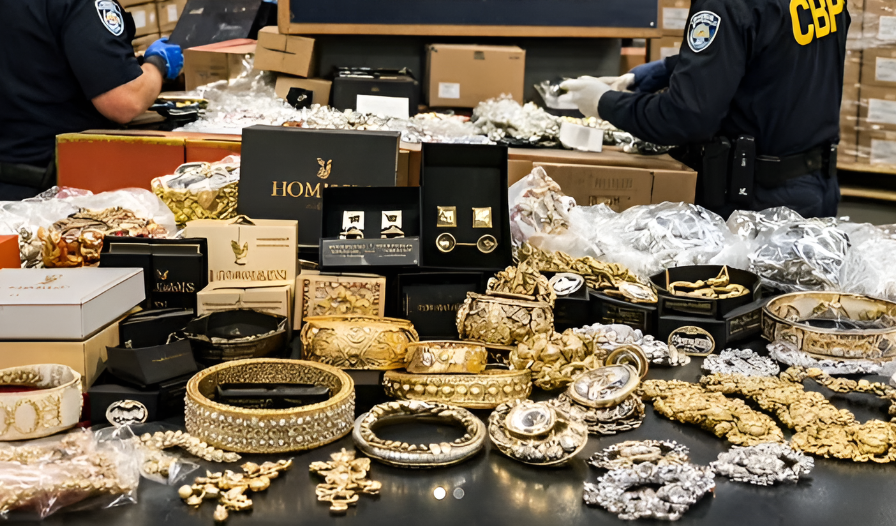
LOUISVILLE, Ky. — US Customs and Border Protection (CBP) officers in Louisville, Kentucky, intercepted a significant shipment of counterfeit goods earlier this month, seizing 1,588 pieces of jewelry from two express consignment shipments. Authorities said the items, if genuine, would have carried a combined Manufacturer’s Suggested Retail Price (MSRP) exceeding $9.2 million, underscoring the scale and value of illicit trade moving through fast-paced logistics channels.
The shipments, originating from Hong Kong and destined for a residence in New York, highlight how counterfeit goods continue to exploit international supply chains and direct-to-consumer delivery systems. The seized items included 691 pairs of earrings, 522 bracelets, 197 necklaces, and 178 rings, bearing the brand names of Cartier, Chanel, Christian Dior, Fendi, Gucci, Louis Vuitton, Tiffany, Van Cleef & Arpels, and Yves Saint Laurent. On suspicion of their authenticity, CBP officers detained the goods for further examination.
The use of express consignment shipments in this case reflects a broader trend in counterfeit trade, where smaller, high-value packages are routed through rapid delivery networks to avoid traditional inspection bottlenecks and reduce detection risks.
To verify the authenticity of the items, CBP officers submitted documentation and product images to the agency’s trade experts at the Consumer Products and Mass Merchandising Center of Excellence and Expertise. The experts coordinated with trademark holders, who confirmed that the goods were counterfeit and subject to seizure. This multi-layered verification process illustrates the critical role of brand collaboration and centralized expertise in modern anti-counterfeiting enforcement.
Louisville Port Director Phil Onken emphasized the broader implications of such seizures, stating, “Illicit trade in counterfeit goods threatens America’s innovation economy, business competitiveness, and the livelihood of US workers.” He also noted that counterfeit products can pose risks to consumer health and safety, while potentially intersecting with wider transnational criminal activities.
With the continued expansion of e-commerce and cross-border logistics, counterfeit and pirated goods are increasingly able to penetrate legitimate supply chains. CBP estimates that American consumers spend more than $100 billion annually on goods that infringe intellectual property rights, accounting for a significant share of counterfeit products circulating globally.
This evolving landscape has made traceability and supply chain transparency more critical than ever. Experts note that identifying the origin, movement, and authentication of goods is becoming increasingly complex as illicit actors adapt to digital commerce and decentralized distribution models.
To address these challenges, CBP has launched its “Truth Behind Counterfeits” educational campaign, aimed at increasing public awareness of the risks associated with counterfeit goods and encouraging informed purchasing decisions. The initiative forms part of broader efforts to strengthen consumer awareness alongside enforcement actions.
Trade in counterfeit consumer goods remains illegal and continues to pose risks beyond economic loss. Such goods can undermine brand integrity, deprive governments of tax revenues, and in some cases be linked to forced labor practices within opaque manufacturing networks.
CBP continues to play a central role in safeguarding supply chains through its Intellectual Property Rights (IPR) enforcement program. In fiscal year 2025 alone, the agency reported seizing more than 78 million counterfeit items, with an estimated MSRP value exceeding $7.3 billion, had the goods been genuine.
Authorities continue to advise consumers to purchase products only from verified and reputable sources, as part of broader efforts to reduce demand for counterfeit goods and strengthen supply chain integrity in an increasingly complex global marketplace.